


To celebrate International Day of People with Disability on 3 December, we spoke with Dr Dinesh Palipana OAM about how technology helps him do the work he loves – caring for patients, teaching and driving change.
Dinesh is a doctor, lawyer, researcher and disability advocate. After a spinal cord injury during medical school, he became Queensland’s first quadriplegic medical intern and Australia’s first doctor with a spinal cord injury. Today, he’s helping to make healthcare and education more inclusive for everyone.
Working in a digital hospital.
“As a world, we’re shifting towards electronic and digital hospitals,” Dinesh says. “That’s a good thing, not just for patients, but for clinicians too. For me, with limited hand function, or someone else who might be blind or have another kind of disability, electronic records help make the job accessible.”
Paper charts, once messy and hard to manage, were replaced by electronic records that could be accessed securely and completed by voice. Voice dictation and AI note-taking tools now help Dinesh record patient notes quickly and clearly. “You just set your phone down and it does the note for you,” he says. “It’s saving time, but also improving accuracy.”
Problem-solving through technology.
Much of the technology Dinesh uses day-to-day has come through a mix of his own problem-solving and working with his colleagues.
“I asked a pharmacist if I could print prescriptions instead of writing them,” he says. “We found a solution together and it actually improved things for the rest of the team too.”
He’s also tried new tools recommended by others, such as a portable ultrasound device that connects to a smartphone. “It’s so easy. Just plug it in and it works. Tech these days is intuitive. You don’t need to be a computer whiz.”
Researching new ways to move.
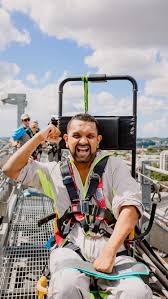
Dinesh isn’t just using technology, he’s helping to advance it. As a co-lead researcher on Project BioSpine at Griffith University, he’s part of a team developing new ways to help people with spinal cord injuries move again. The project uses virtual reality to help participants see and feel themselves walking, with sensors that pick up brain signals and translate them into movement on screen.
The team hopes that combining virtual reality with muscle stimulation and targeted drug therapy will one day help people walk again outside the lab. “We live in a time where there’s so much technology. We’ve got the computing power now. We’ve got the broadband. We’ve got everything,” he says. “It’s limited just by our imagination.”
Everyday tech that makes life easier.
Outside the hospital, technology also plays a big role in helping Dinesh live independently. His home has been designed with automation in mind.
“I can say ‘Hey Siri’ and open the curtains, turn on the vacuum cleaner or switch on the lights,” he says. “Voice control has been a game changer.”
From power-assisted wheelchair wheels to Bluetooth-connected diagnostic tools, Dinesh uses a combination of high and low-tech devices that allow him to stay mobile, efficient and self-reliant.
Not every tool needs to be complex. Sometimes, it’s the small things, like a specially selected pen, that make all the difference. “The right pen means I can write when I need to. But now, I hardly ever use one thanks to tech.”
Technology may be the tool, but mindset matters.
Technology plays a part in Dinesh’s independence, but mindset matters just as much. “It’s okay to acknowledge that things are hard,” he says. “But this is the life we’ve got and there are tools to help us live it fully.”
He sees hardship as part of growth. Each obstacle has taught him something new about what’s possible. “It’s through those challenges that I’ve learned what I’m capable of. That’s what keeps me moving forward.”
If you’d like help to understand how assistive technology fits in your NDIS Plan, the Leap in! Crew can help. Call us 1300 05 78 78, email [email protected] or chat with us on our website.